Technical 3D printing and functional parts
Need a functional part, jig or prototype? We assess the design, material and actual operating conditions. We focus on technical and load-bearing parts as well as large-format manufacturing, not just the grams consumed.
Materials, dimensions and lead time
- How long does 3D printing take?
- Timing depends on size, material, printing time and production workload. We can usually complete smaller parts within a few working days; large-format or more complex projects are scheduled individually. We confirm a specific date in the quotation before production begins.
- How large a part can you print in one piece?
- Our Sovol SV08 Max printers have a build volume of up to 500 x 500 x 500 mm. The usable dimensions depend on the geometry, material and settings for the particular job. Larger objects can be split into parts and assembled afterwards.
- Which materials and technologies do you use?
- For FDM printing, we use materials such as PLA, PETG, ASA, ABS or TPU, depending on the purpose. We choose resin where fine detail matters. We recommend a material based on mechanical loads, temperature, environment and the required appearance.
Your requirements
Who the service is for
For development teams, manufacturing and service companies that need to verify a design, replace a part or manufacture a small batch. We can also arrange smaller FDM prints and resin according to the requirements.
What we need to get started
- The purpose of the part and its operating conditions, including loads and temperature
- A model, drawing or photographs with approximate dimensions
- Quantity, required date and any repeat production
- Identified critical dimensions, functional surfaces and required inspection
How we work together
From requirements to a usable output
Assess the purpose and model
We clarify the use, dimensions, quantity and loads. We check printability; a missing model or extensive data repairs are quoted separately.
Choose material and technology
We recommend FDM or resin according to function, temperature, environment and appearance. We also agree critical dimensions and the inspection scope.
Prepare the data and machine
We choose part orientation, supports and slicing: converting the model into print layers and toolpaths. We prepare the machine and material for the particular job.
Manufacture with supervision
We provide printing and ongoing supervision. For batches, we check the first part where needed; any deviation found is addressed before production continues.
Finish, inspect and hand over
We remove supports, carry out basic inspection and complete the agreed finishing work. We hand over the output according to the approved requirements and collection arrangements.
The result
What you receive
- A manufactured part or batch according to the approved requirements
- The agreed material, orientation and level of finishing
- Basic inspection and separately agreed verification of critical dimensions
- Handover and recommendations for any further modifications or manufacturing
Practical uses
Material chosen for what the part needs to do
- Functional and load-bearing components
- For brackets, jigs or parts for robotics development, we assess forces, stiffness, layer orientation and mating surfaces. The selected material must suit the specific conditions.
- Prototypes and dimensional checks
- For a first prototype, shape and fit may be the main priorities. A functional test also requires considering the material and production settings. We distinguish these two goals in the requirements.
- Smaller FDM parts and resin
- Based on mechanical, thermal, chemical and appearance requirements, we recommend an FDM material or resin for fine detail. Small size alone does not determine production simplicity or cost.
- Large parts and assemblies
- For large-format work, we check the usable build volume, deformation and any need to split the model. Joints are designed for their function, not merely to fit the part into a printer.
Scope and pricing
A quotation based on your requirements
We prepare a quotation after assessing the model or requirements. The price includes the agreed print and work around production; material weight alone does not decide it. We list modelling, demanding finishing and special tests separately.
What affects the price
- Material, part volume and machine time
- Quantity and batch repeatability
- Data checks and preparation, orientation and supports
- Post-processing, assembly and required surface finish
- Critical dimensions, inspection scope and any tests
- Timing, splitting a large part and handover arrangements
Rules and responsibility
We agree capabilities and limitations in advance
- Load capacity depends on design, material, layer orientation, production settings and the actual loads applied. Without assessment and appropriate testing, we do not promise universal load capacity or a safety guarantee.
- Identify critical dimensions and functional surfaces before production. We will agree tolerances and an inspection method; basic inspection does not automatically guarantee the accuracy of every dimension.
- We choose material according to mechanical, thermal, chemical and appearance requirements. A material name alone is not enough to confirm suitability for a particular use.
- CAD modelling, major data repairs and design changes are agreed separately. If a technology other than 3D printing is more suitable, we will say so before work begins.
Follow-on collaboration
Without a finished model, we can first assess a photograph or sketch. Modelling and reverse engineering have their own scope; repeat production from prepared data can be handled through printing capacity.
From the brief to the result.
3D printing and models · Completed project
The estimate was 500 kg. The ramp withstood a load of 7,000 kg.
The ramp weighs approximately 5 kg, measures 700 mm, and its height ranges from 100 to 150 mm. A technician originally estimated its load capacity at 400 to 500 kg.
Actual output
That is approximately fourteen times the original technical estimate and 1,400 times the weight of the ramp itself.
3D printing and models · Completed project
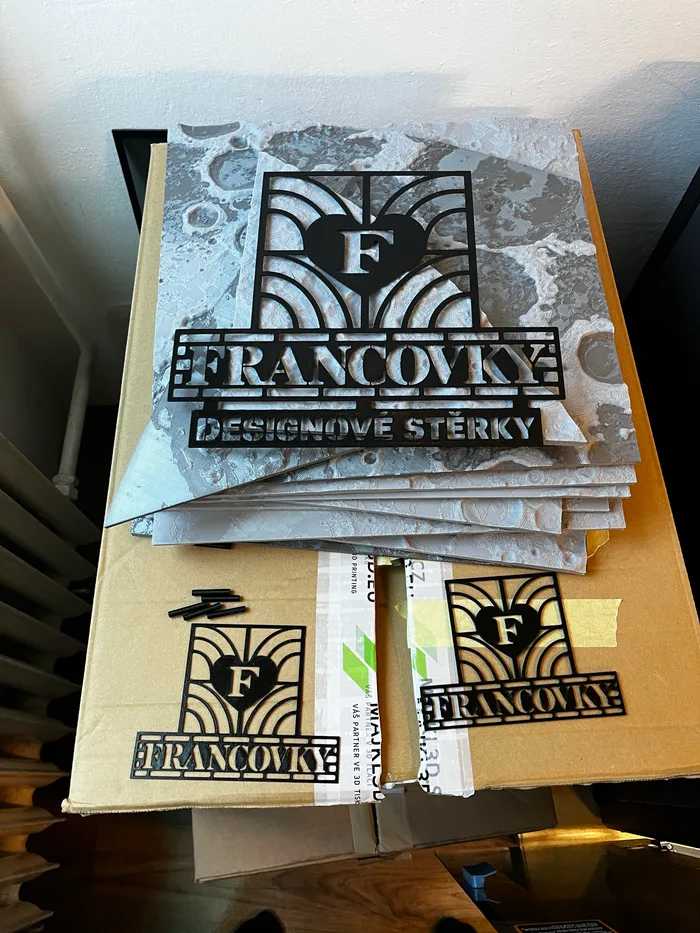
Custom plaster stencils
Made-to-order stencils for decorative plaster with different patterns. We delivered this project within 24 hours, from the initial idea through a prototype to 3D printing.
Actual output
Finished physical stencils for creating patterns in decorative plaster. The photograph shows this particular order.
3D printing and models · Completed project
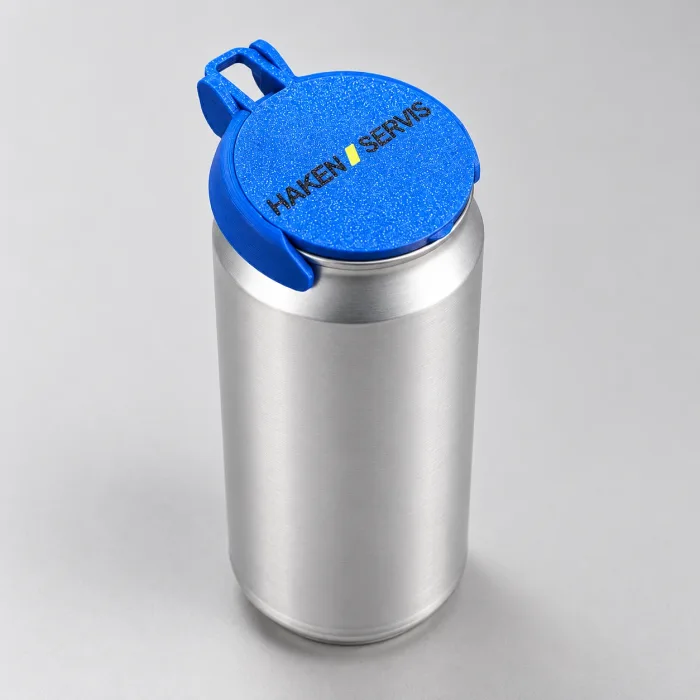
Manufactured can lid samples with custom branding
Physical flip-top can lid samples manufactured by 3D printing. The blue HAKEN SERVIS and black KK make IT versions demonstrate custom branding; these are samples, not a customer delivery.
Actual output
Physical flip-top lid samples carrying HAKEN SERVIS and KK make IT branding. The presentation images are AI-edited versions of photographs of the actual prints.
3D printing and models · Completed project
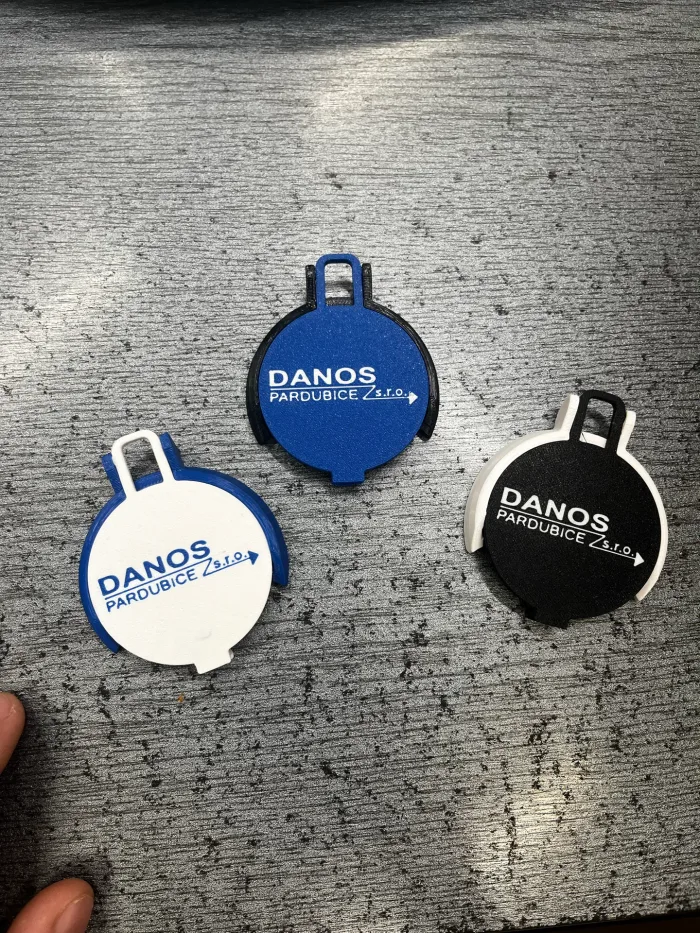
Lids and keyrings for DANOS
A completed and delivered order of 250 lids and 5 keyrings with NFC and QR codes.
Actual output
We delivered 250 lids and 5 keyrings to the customer. NFC and QR codes link to the company website and contact details.
3D printing and models · Completed project
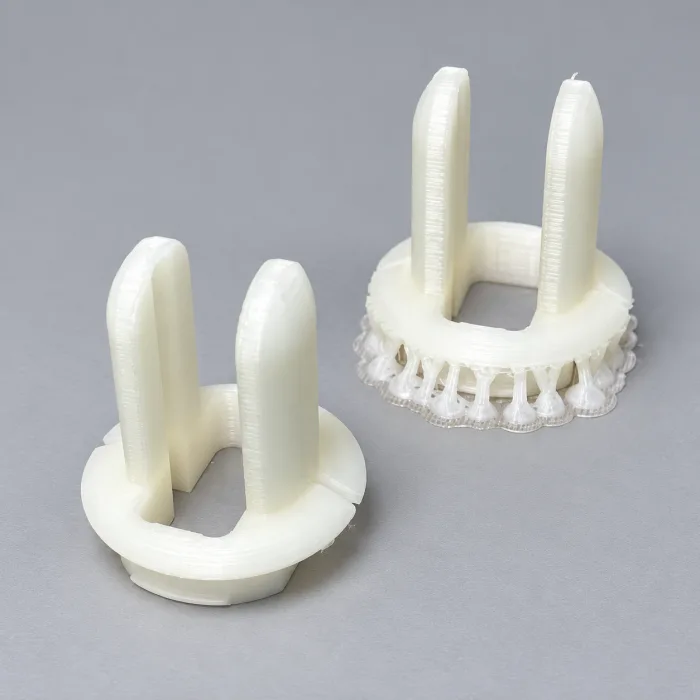
Custom PA6 machine parts
A company needed additional parts for its machinery. We manufactured them by custom 3D printing in PA6 (polyamide 6).
Actual output
Custom PA6 prints for a business customer. This is a completed project, not a universal replacement part available from a catalogue.
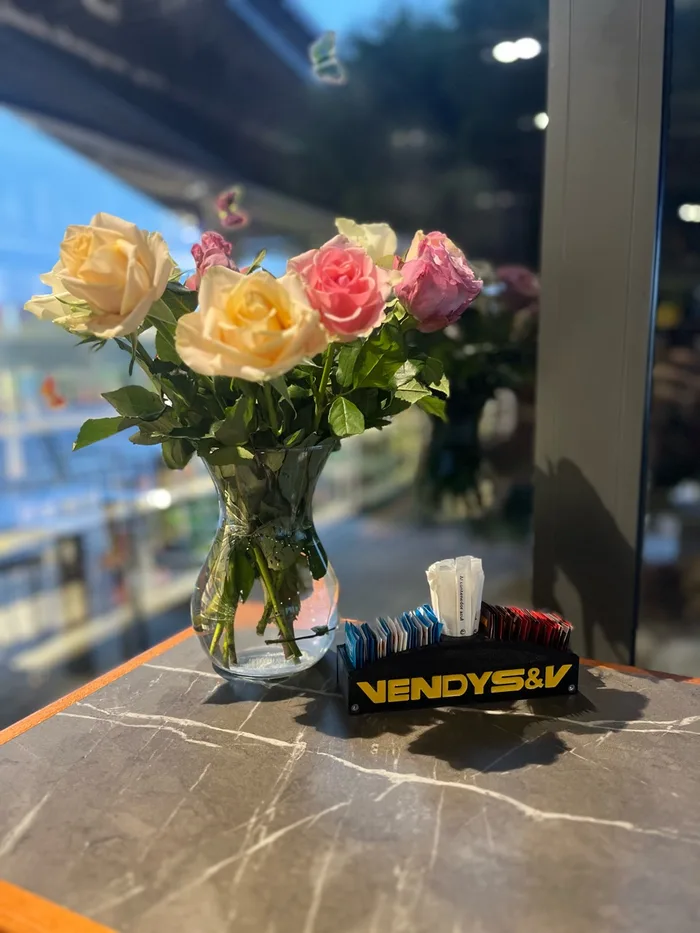
3D printing and models · Completed project
Vendy’s & V modular stand
Ten stands for salt and pepper sachets and accessories are in use at the Vendy’s & V premises. Their three-part construction allows the front and rear panels to be changed for a season or event.
Actual output
10 manufactured stands with interchangeable panels are in use at the Vendy’s & V premises for organising sachets and accessories on a counter. The front panel carries the Vendy’s & V name.
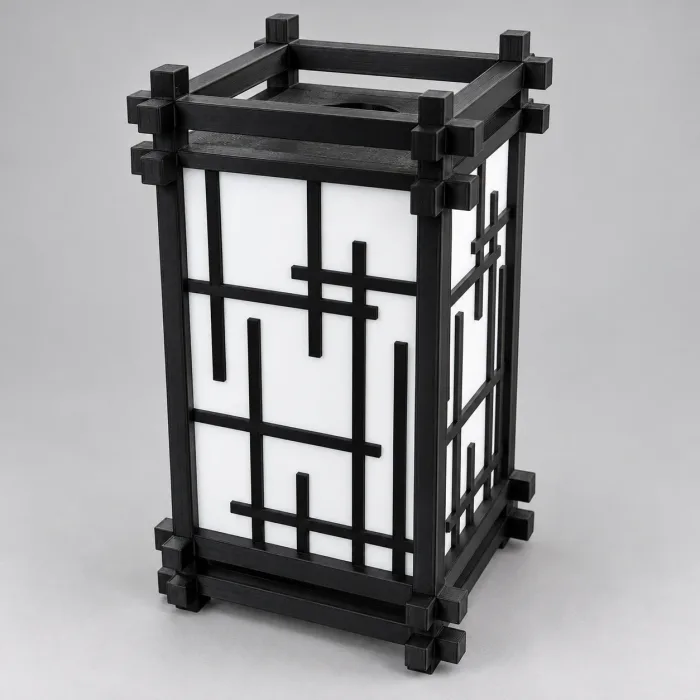
3D printing and models · Completed project
Lamp for a sheltered patio
A black-and-white lamp body with a geometric frame, made by 3D printing. An example of custom manufacturing for the home or a covered garden patio.
Actual output
A finished physical lamp body. The shop distinguishes between the body alone and a version with an LED light and mains power supply.
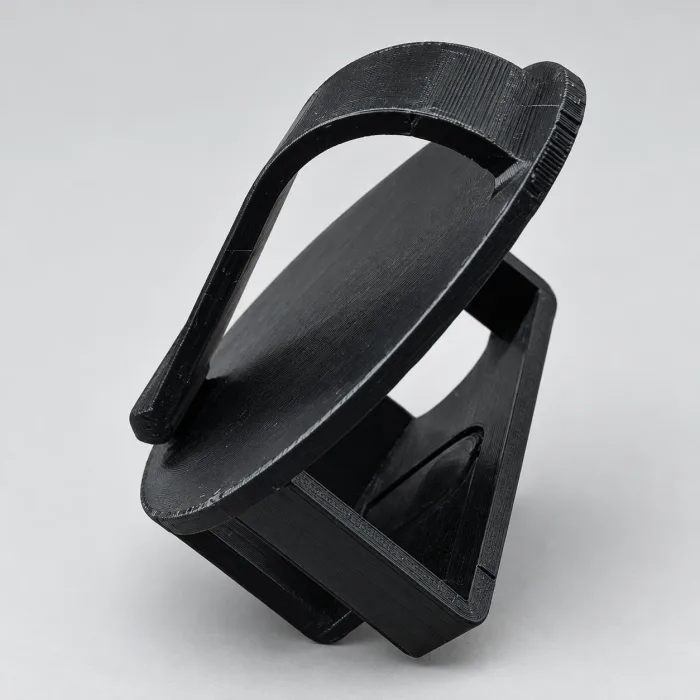
3D printing and models · Completed project
Manufactured car container holder prototype
A manufactured sample/prototype of a 3D-printed VELO container holder for mounting behind the driver’s sun visor. A customer delivery has not been confirmed.
Actual output
A physical plastic sample/prototype holder for mounting behind a sun visor. A customer delivery has not been confirmed. The offer is for the holder only, without the container or its contents.
Before we get started
Frequently asked questions
What kinds of parts and projects suit 3D printing?
Prototypes, jigs, housings, replacement parts and small batches where manufacturing in plastic from a digital model makes sense. For a large part, we assess printing it in one piece or splitting it. Tailored printing capacity is suitable if you have models ready and need manufacturing capacity.
How long does 3D printing take?
Timing depends on size, material, printing time and production workload. We can usually complete smaller parts within a few working days; large-format or more complex projects are scheduled individually. We confirm a specific date in the quotation before production begins.
How large a part can you print in one piece?
Our Sovol SV08 Max printers have a build volume of up to 500 x 500 x 500 mm. The usable dimensions depend on the geometry, material and settings for the particular job. Larger objects can be split into parts and assembled afterwards.
Which file formats do you accept?
We mainly accept STL, OBJ, STEP, 3MF and DXF. If you do not have a model, send a photograph, basic dimensions and a description of its use. Depending on the requirements, we will recommend modelling, 3D scanning or reverse engineering.
Which materials and technologies do you use?
For FDM printing, we use materials such as PLA, PETG, ASA, ABS or TPU, depending on the purpose. We choose resin where fine detail matters. We recommend a material based on mechanical loads, temperature, environment and the required appearance.
Do you offer finishing work?
Yes. Depending on the project, we can provide support removal, basic cleanup, sanding, painting or assembly. The scope of finishing work is always listed separately in the quotation.
What is the difference between custom printing and printing capacity?
Custom printing focuses on a specific product and result. Printing capacity is managed production capacity for customers with data ready who need a machine, print preparation, supervision and basic output checks.
How do you price a print or a batch?
We assess material, volume, machine time, quantity, data preparation, supports, finishing and inspection. The quotation covers a specific print or production scope, not just a number of grams or hours. Modelling, express work and non-standard work are agreed separately.
How do you handle load capacity and critical dimensions?
Load capacity depends on the design, material, layer orientation and how the load is applied. Identify critical dimensions and functional surfaces in advance; we will agree tolerances, inspection and any testing needed. We do not promise universal load capacity or accuracy for every dimension without assessment.
How does a project proceed and what do you hand over?
First we clarify the purpose, dimensions, quantity and material requirements. We check printability, agree a price and date, and prepare production. We hand over printed parts with the agreed cleanup and inspection. A CAD model, measurement report or demanding surface finishing is included only when specified in the quotation.
Related services
Back to the 3D divisionLet us discuss your part or manufacturing requirements
Describe the purpose, approximate dimensions and quantity. Attach approved photographs or technical materials; if you are unsure about the output, we will suggest an approach.