Large-format 3D printing
A large part needs more than a large printer. On the Sovol SV08 Max, we work with a build volume of up to 500 x 500 x 500 mm. We verify the usable dimensions based on geometry, material, orientation and required quality.
Materials, dimensions and lead time
- How long does 3D printing take?
- Timing depends on size, material, printing time and production workload. We can usually complete smaller parts within a few working days; large-format or more complex projects are scheduled individually. We confirm a specific date in the quotation before production begins.
- How large a part can you print in one piece?
- Our Sovol SV08 Max printers have a build volume of up to 500 x 500 x 500 mm. The usable dimensions depend on the geometry, material and settings for the particular job. Larger objects can be split into parts and assembled afterwards.
- Which materials and technologies do you use?
- For FDM printing, we use materials such as PLA, PETG, ASA, ABS or TPU, depending on the purpose. We choose resin where fine detail matters. We recommend a material based on mechanical loads, temperature, environment and the required appearance.
Your requirements
Who the service is for
For companies developing large functional parts, technical prototypes, jigs, housings and assemblies. For each project, we first assess whether one piece, splitting or another manufacturing technology is more suitable.
What we need to get started
- The purpose of the part and its operating conditions, including loads and temperature
- A model, drawing or photographs with approximate dimensions
- Quantity, required date and any repeat production
- Identified critical dimensions, functional surfaces and required inspection
How we work together
From requirements to a usable output
Check dimensions and function
From the model and requirements, we check the part envelope, loads and functional surfaces. The nominal build volume does not automatically guarantee any print of the same size.
Propose orientation or splitting
We consider material, supports, deformation and layer direction. If the part does not fit, we assess splitting it, joint positions and assembly.
Agree material and inspection
We choose production settings, identify critical dimensions and define an inspection procedure. Joint design or engineering changes are priced separately.
Manufacture and finish
We prepare slicing and the machine, provide supervised printing, remove supports and complete agreed finishing. For a split part, we carry out the agreed assembly.
Verify the agreed parameters
We check the output against the requirements and hand over the part or assembly. Professional measurement and load testing are not automatically included in every print.
The result
What you receive
- A large part or a split assembly agreed in advance
- Material and a manufacturing process suited to the requirements
- Agreed finishing and a method for joining individual parts
- Inspection within the approved scope and output handover
Practical uses
Options for a large part
- One piece within 500 x 500 x 500 mm
- The Sovol SV08 Max allows large prints. The actual usable volume depends on geometry, orientation, material, supports and the required surface quality.
- A split assembly larger than the build volume
- A structurally suitable model can be manufactured in sections. We design joints, mating surfaces and assembly in advance; not every shape can be split without affecting its function.
- A load-bearing technical prototype
- For a loaded part, we assess the design, layers, material, joints and actual loads. The result of one test cannot be applied to all products.
Scope and pricing
A quotation based on your requirements
We set the exact price and timing from the model or requirements. For a large part, orientation, supports, print duration, deformation risk and joint work matter significantly; dimensions alone do not determine the price.
What affects the price
- Material, part volume and machine time
- Quantity and batch repeatability
- Data checks and preparation, orientation and supports
- Post-processing, assembly and required surface finish
- Critical dimensions, inspection scope and any tests
- Timing, splitting a large part and handover arrangements
Rules and responsibility
We agree capabilities and limitations in advance
- Load capacity depends on design, material, layer orientation, production settings and the actual loads applied. Without assessment and appropriate testing, we do not promise universal load capacity or a safety guarantee.
- Identify critical dimensions and functional surfaces before production. We will agree tolerances and an inspection method; basic inspection does not automatically guarantee the accuracy of every dimension.
- We choose material according to mechanical, thermal, chemical and appearance requirements. A material name alone is not enough to confirm suitability for a particular use.
- CAD modelling, major data repairs and design changes are agreed separately. If a technology other than 3D printing is more suitable, we will say so before work begins.
- For a split design, we do not promise invisible joints, the original strength or the same dimensional accuracy without assessment and verification. The joint is part of the design and must suit the loads.
Follow-on collaboration
Smaller components can complement a large assembly. For prepared print data and repeat batches, we propose managed manufacturing capacity; where a model is missing, design work comes first.
From the brief to the result.
3D printing and models · Completed project
The estimate was 500 kg. The ramp withstood a load of 7,000 kg.
The ramp weighs approximately 5 kg, measures 700 mm, and its height ranges from 100 to 150 mm. A technician originally estimated its load capacity at 400 to 500 kg.
Actual output
That is approximately fourteen times the original technical estimate and 1,400 times the weight of the ramp itself.
3D printing and models · Completed project
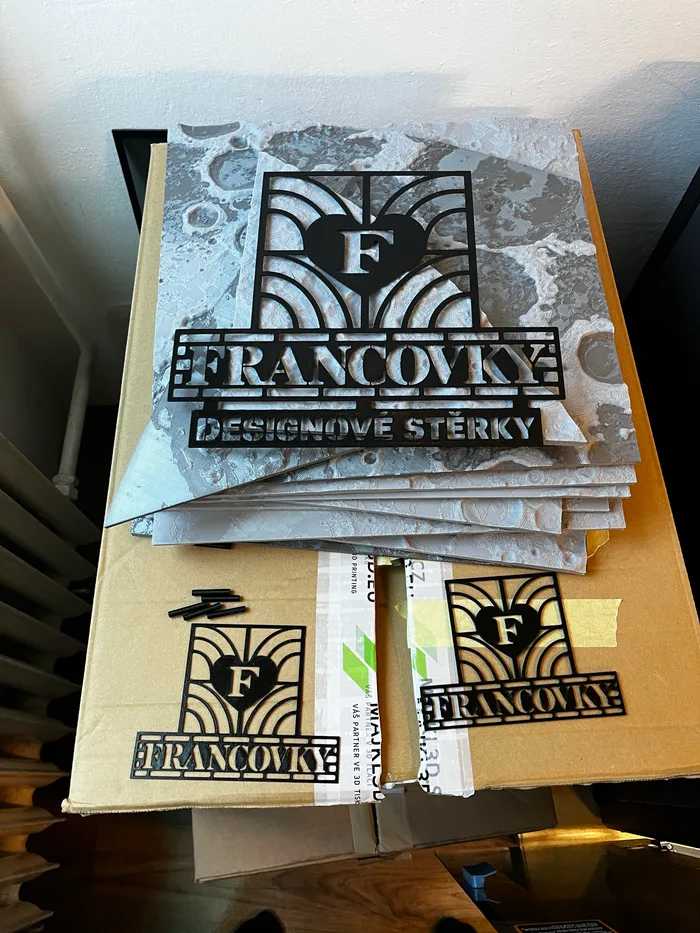
Custom plaster stencils
Made-to-order stencils for decorative plaster with different patterns. We delivered this project within 24 hours, from the initial idea through a prototype to 3D printing.
Actual output
Finished physical stencils for creating patterns in decorative plaster. The photograph shows this particular order.
3D printing and models · Completed project
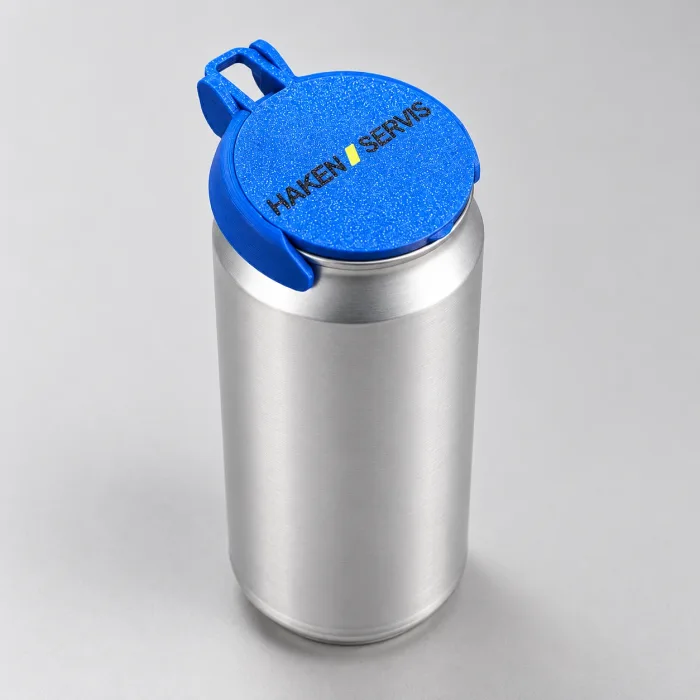
Manufactured can lid samples with custom branding
Physical flip-top can lid samples manufactured by 3D printing. The blue HAKEN SERVIS and black KK make IT versions demonstrate custom branding; these are samples, not a customer delivery.
Actual output
Physical flip-top lid samples carrying HAKEN SERVIS and KK make IT branding. The presentation images are AI-edited versions of photographs of the actual prints.
3D printing and models · Completed project
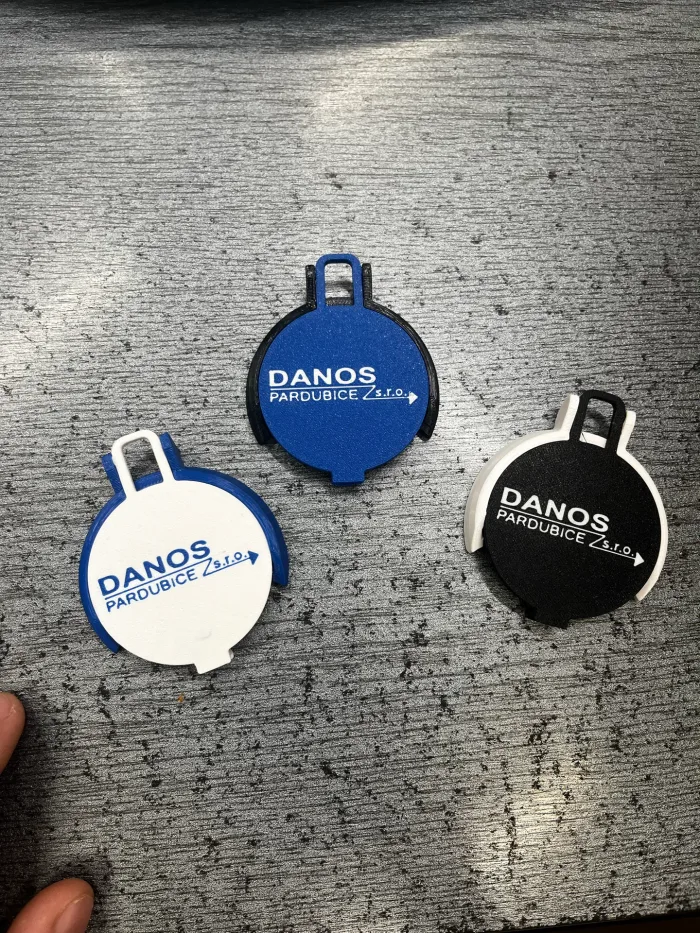
Lids and keyrings for DANOS
A completed and delivered order of 250 lids and 5 keyrings with NFC and QR codes.
Actual output
We delivered 250 lids and 5 keyrings to the customer. NFC and QR codes link to the company website and contact details.
3D printing and models · Completed project
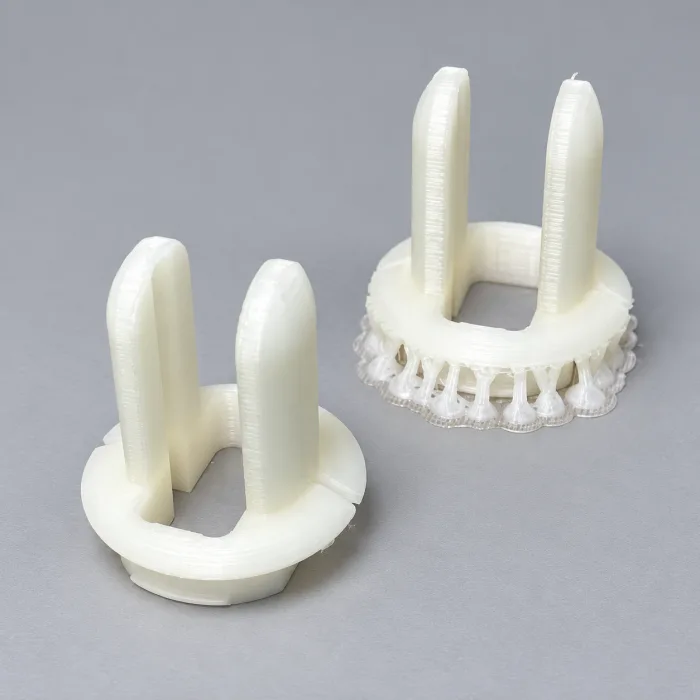
Custom PA6 machine parts
A company needed additional parts for its machinery. We manufactured them by custom 3D printing in PA6 (polyamide 6).
Actual output
Custom PA6 prints for a business customer. This is a completed project, not a universal replacement part available from a catalogue.
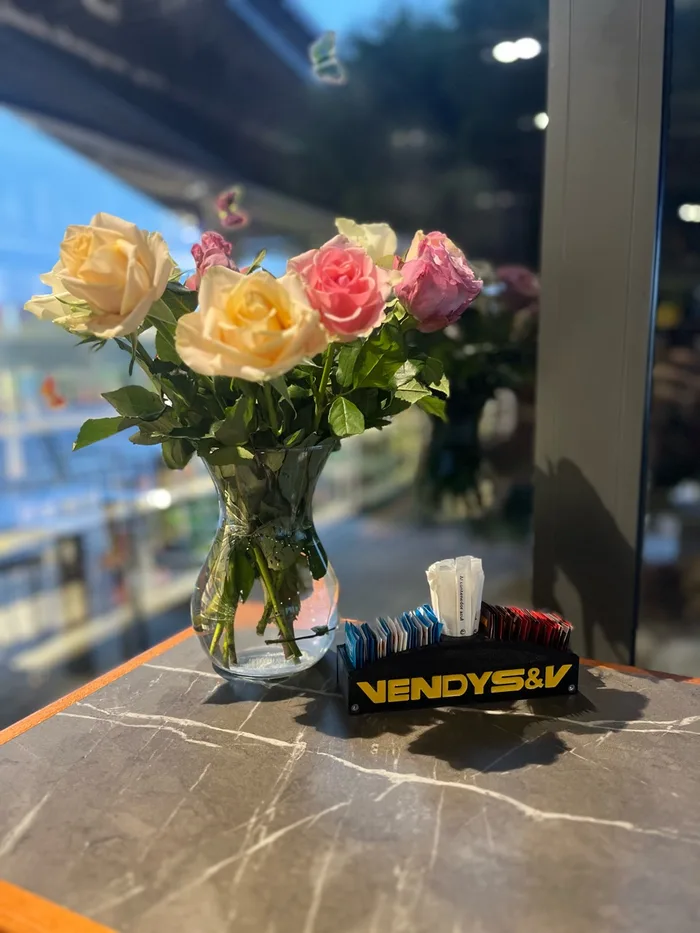
3D printing and models · Completed project
Vendy’s & V modular stand
Ten stands for salt and pepper sachets and accessories are in use at the Vendy’s & V premises. Their three-part construction allows the front and rear panels to be changed for a season or event.
Actual output
10 manufactured stands with interchangeable panels are in use at the Vendy’s & V premises for organising sachets and accessories on a counter. The front panel carries the Vendy’s & V name.
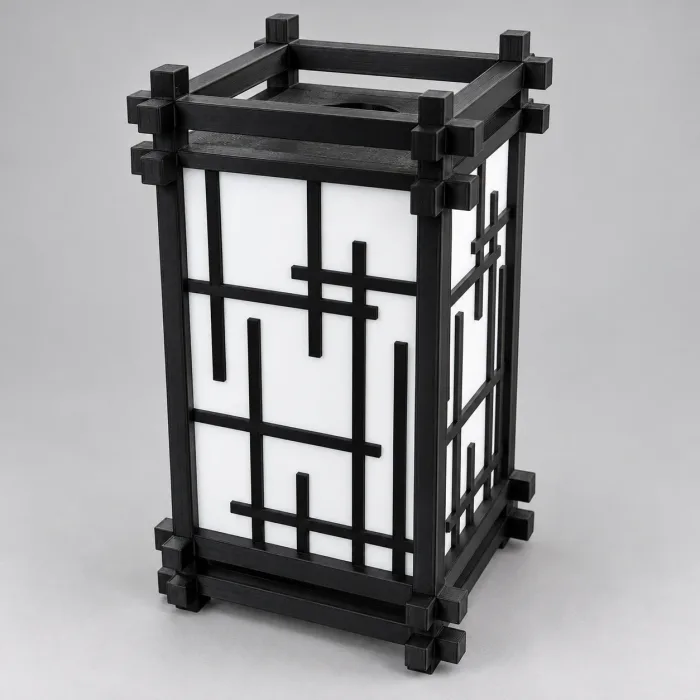
3D printing and models · Completed project
Lamp for a sheltered patio
A black-and-white lamp body with a geometric frame, made by 3D printing. An example of custom manufacturing for the home or a covered garden patio.
Actual output
A finished physical lamp body. The shop distinguishes between the body alone and a version with an LED light and mains power supply.
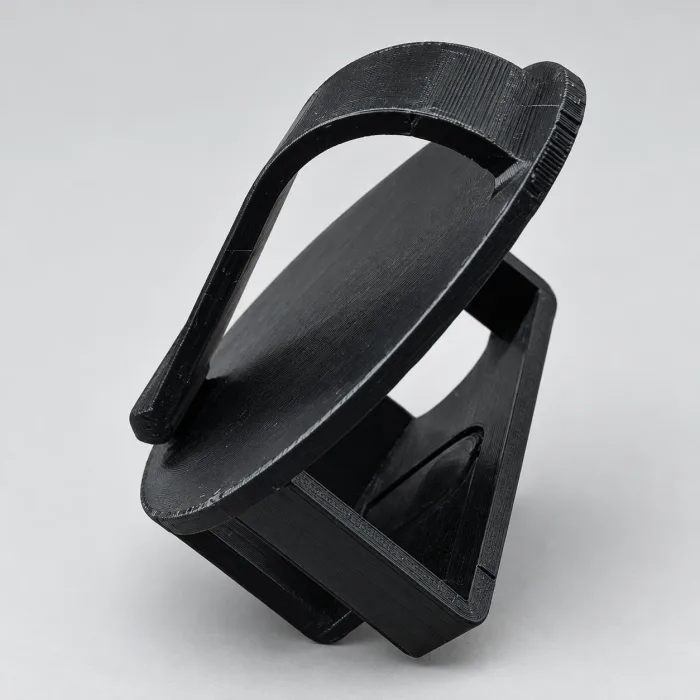
3D printing and models · Completed project
Manufactured car container holder prototype
A manufactured sample/prototype of a 3D-printed VELO container holder for mounting behind the driver’s sun visor. A customer delivery has not been confirmed.
Actual output
A physical plastic sample/prototype holder for mounting behind a sun visor. A customer delivery has not been confirmed. The offer is for the holder only, without the container or its contents.
Before we get started
Frequently asked questions
What kinds of parts and projects suit 3D printing?
Prototypes, jigs, housings, replacement parts and small batches where manufacturing in plastic from a digital model makes sense. For a large part, we assess printing it in one piece or splitting it. Tailored printing capacity is suitable if you have models ready and need manufacturing capacity.
How long does 3D printing take?
Timing depends on size, material, printing time and production workload. We can usually complete smaller parts within a few working days; large-format or more complex projects are scheduled individually. We confirm a specific date in the quotation before production begins.
How large a part can you print in one piece?
Our Sovol SV08 Max printers have a build volume of up to 500 x 500 x 500 mm. The usable dimensions depend on the geometry, material and settings for the particular job. Larger objects can be split into parts and assembled afterwards.
Which file formats do you accept?
We mainly accept STL, OBJ, STEP, 3MF and DXF. If you do not have a model, send a photograph, basic dimensions and a description of its use. Depending on the requirements, we will recommend modelling, 3D scanning or reverse engineering.
Which materials and technologies do you use?
For FDM printing, we use materials such as PLA, PETG, ASA, ABS or TPU, depending on the purpose. We choose resin where fine detail matters. We recommend a material based on mechanical loads, temperature, environment and the required appearance.
Do you offer finishing work?
Yes. Depending on the project, we can provide support removal, basic cleanup, sanding, painting or assembly. The scope of finishing work is always listed separately in the quotation.
What is the difference between custom printing and printing capacity?
Custom printing focuses on a specific product and result. Printing capacity is managed production capacity for customers with data ready who need a machine, print preparation, supervision and basic output checks.
How do you price a print or a batch?
We assess material, volume, machine time, quantity, data preparation, supports, finishing and inspection. The quotation covers a specific print or production scope, not just a number of grams or hours. Modelling, express work and non-standard work are agreed separately.
How do you handle load capacity and critical dimensions?
Load capacity depends on the design, material, layer orientation and how the load is applied. Identify critical dimensions and functional surfaces in advance; we will agree tolerances, inspection and any testing needed. We do not promise universal load capacity or accuracy for every dimension without assessment.
How does a project proceed and what do you hand over?
First we clarify the purpose, dimensions, quantity and material requirements. We check printability, agree a price and date, and prepare production. We hand over printed parts with the agreed cleanup and inspection. A CAD model, measurement report or demanding surface finishing is included only when specified in the quotation.
Related services
Back to the 3D divisionLet us discuss your part or manufacturing requirements
Describe the purpose, approximate dimensions and quantity. Attach approved photographs or technical materials; if you are unsure about the output, we will suggest an approach.